
Abstract
Aims: Meditation is a technique for resting the mind leading to peace, happiness, bliss and self- realization. There are a large number of meditation techniques in the world. Tibetan singing sound meditation is one such best techniques in which include a harmonies sound. So sound helps to bring harmony on all the aspects of life. Objectives: The objective of the present investigation is to study the “Effect of Sound meditation on increased anxiety & stress in women.” Material and methods: The research method adopted for the study was a quantitative research approach. The research design was a “pre-post experimental group design”. Non-probability quota sampling method was used for the study. 20 Women’s (25-45 years old) were selected from Dev Sanskrit Vishwavidyalay, Hardwar. It has been established by the experience as well as the experiments that the correct frequency of sound, along with the correct in cent, helps the women’s oxygenate the brain, reduce heart rate, blood pressure, get cured by many ailments, create calm brainwave activity and achieve immunity from outside mental disturbances. Anxiety, stress along with two anxieties related parameters GSR and alpha-electroencephalogram (EEG) was investigated in order to assess its efficacy as an inexpensive therapeutic technique. Sinha’s comprehensive anxiety test was used to measure anxiety. Galvanic skin resistance (GSR) and alpha EEG (electroencephalogram) brain waves were also investigated for the validation of results. Results: Data was analysed by using student t-test. Clinically significant results were found at .01 levels. Conclusion: This indicates that during meditation, the brain transitions from an active, alert state (beta) to a more relaxed, calm state (alpha and theta). Through this, primarily to enhance the capacity of brain and other internal organs, so that individual can use their powers properly for the best use being physically and mentally healthy (peace, happiness, bliss and self- realization). Sound meditation can be very effective as a therapeutic technique against anxiety & stress.
Keywords: Sound meditation, Singing bowl, Anxiety, Stress, Women
Introduction
Mental disorders are among the strongest contributors to the global burden of disease, and conventional therapies are not always effective (Turner et al. 2008).1 In the USA it has been observed that as much as 21.3% of CAM users have mental disorders, and that many CAM users with mental disorders also receive some form of conventional care (Cuijpers et al. 2011)2 and that 9.8% of persons reporting a mental disorder made a CAM visit Several studies, all conducted in high-income countries, have found that CAM use depends on the kind and severity of disorder: anxiety and mood disorders, in particular, have been associated with increased CAM use, but also the presence of alcohol disorder (particularly with self-help groups) (Steven K.H. Aung, Mathew H.M. Lee;2004)3 It has been suggested that CAM use is concentrated among persons with relatively mild and transient forms of distress (Druss & Rosenheck, 2000). Women account for almost 50% 0f all cardiovascular deaths annually and 43% women compared with 24% men will die within one year following heart attack (WHO, 2003).4
Complementary and alternative medicine (CAM) is not part of conventional medicine as practiced by medical doctors and allied health professionals, but is still part of how society deals with health problems, including mental disorders (Kessler et al. 2001)The use of CAM in the USA increased during the nineties to an extent that the out-of-pocket payments relating to CAM use were equal to those for hospitalisations and physician services (Eisenberg et al. 1998). In low-income countries, conventional care resources are less often available and sometimes CAM even constitutes the only resource. For instance, up to 80% of the population in Africa depends on CAM for their primary source of care (WHO Factsheet 2003). CAM includes a wide list of self-care interventions, such as taking natural products or doing meditation, tai chi or yoga, participation in self-help groups through the internet, or visits to all sort of therapists and healers, and is often differentiated from religious providers (Kessler et al. 2001).5
Meditation is a technique for resting the mind leading to peace, happiness, bliss and self- realization. There are a large number of meditation techniques in the world. Tibetan singing sound meditation is one such best techniques in which include a harmonies sound. So sound helps to bring harmony on all the aspects of life. The objective of the present investigation is to study the “Effect of Sound meditation on increased anxiety & stress in women.”
“Meditation is not just for relaxation its primary purpose is to develop the capacity to respond skillfully and gracefully to life’s difficulties as well as its joys”. (Shyalpa tenzin Rinpoche)
Stress and anxiety are a big problem in our society (Coleman, 1967).6 Some 75% of bodily disease are said to be related. It is called psychosomatic disorders. For example – stress and anxiety is often a factor in heart disease and cancer, two of the leading causes of death. According to the General adaptation syndrome theory, the immediate response to stress (Alarm stage) involves the mobilization of most body systems to meet the challenges. However, if the stress continues, the body wears down and death may result (stage of exhaustion) (Lundberg & Marianne, 1999).7 Anxiety is the most commonly diagnosed mental illness in the USA, with over 19% of US adults having a diagnosable anxiety disorder. During the 2020 pandemic, anxiety levels continued to rise as people were often unable to rely on usual social support or obtain in-person medical treatments to ameliorate anxiety.2 Anxiety during the pandemic continued to rise to levels estimated at 31.9%, with the percentage of those reporting an unmet mental health care need rising from 9.2% to 11.4%.
What is Sound Healing?
Sound therapy is essentially the process of healing the mind and body through music, tones, frequencies, and vibrations. Sound therapy takes into consideration a person’s emotional, mental, psychological, spiritual well- being and improvement. According to Ancient science there is a mantra in Naad Bindu Upnishad which says – Sound is God, Sound is Creator.
“Shabd Brahma – Naad Brahma” (Naad Bindu Upnishad)8
Sound healing is the use of specific instruments, music, tones, and other sonic vibrations to balance and heal the body, mind, and spirit. It involves using specialized sound frequencies to create a therapeutic atmosphere to promote deep rest, nervous system rebalancing, and emotional release.
Sound therapy is neurological music therapy, where you listen, sing, or move to music. This is more commonly used for physical rehabilitation, pain management and brain injuries as well as stress reduction and relaxation purposes (Acharya shree ,2001).9
Objectives of the research
- To assess the level of anxiety and stress of women before administering Meditation.
- To assess the anxiety and stress level of women with after administering Meditation.
- To assess the Alfa EEG (electroencephalogram) level of women.
- To assess the Galvanic skin resistance (GSR) level of women.
literature review
harping GR.Jones SB, Hancock B, Knott VE, Bowden JA, Whitford HS.et al. 2010 : A meta-analysis of randomized controlled study was conducted regarding meditative therapies for reducing anxiety. Major medical data bases were searched thoroughly with key words related to various types of meditation and anxiety. Over 1,000 abstracts were screened and 200 full articles were reviewed. The Boutros check list to evaluate a non- pharmacological trial was used to assess study quality. The results suggested that a total of 36 randomized controlled trials were included among this 25 studies reported statistically superior outcomes in the meditation group compared to control.
Goldin P, Ziy M,Jazaieri H, Hahn K, Gross JJ. Mindfulness Based Stress Reduction versus exercise in social anxiety. Soc .Conqn Affect Neurosci (2012) A prospective study conducted to identify whether meditation is an intervention for depression and anxiety among cancer patients. It involves sixteen participants with a history of cancer and five careers of people with cancer recruited from August 2008 to February 2009 through calls to the cancer council South Australia help line. Participants were assessed for anxiety before and after undergoing course of meditation. Anxiety and depression measured by Spielberg State Anxiety Inventory and Beck Depression Inventory. The results suggested that there were significant reduction in anxiety and depression (P=0.001, P= 0.012).The study concluded that meditation appears to be an efficacious intervention for use among people affected by cancer who also experiences symptoms of depression and anxiety. Stress is an imminent public health problem and one of the approaches to address this problem is through mindfulness-based stress reduction. A total of 17 interventions from January 2008 to December 2013 looked at mindfulness-based stress reduction and its efficacy in decreasing stress in healthy individuals. Of these reviewed studies, all interventions were able to find some positive effects in psychological or physiological outcome measures related to stress. Despite the limitations of not all studies using randomized controlled design, having smaller sample sizes, and having different outcome measures, mindfulness-based stress reduction is a promising modality for stress management among healthy individuals. All practitioners teaching stress management must include mindfulness-based stress reduction as one of the approaches for stress reduction. (Kirandeep kaur,2022)10
Research Methodology
The role of methodology is to carry on the research work in a scientific and valid manner. The methodology consists of procedures and techniques for conducting a study. Research methodology includes research design, approach, setting, population, and sample, sampling technique, description of tool, method of data collection and plan for data analysis.
The research method adopted for the study was a quantitative research approach. The research design was a “pre-post experimental group design”. Non-probability quota sampling method was used for the study. 20 Women’s (25-45 years old) were selected from Dev Sanskriti Vishwavidyalaya, Haridwar. It has been established by the experience as well as the experiments that the correct frequency of sound, along with the correct incent, helps the women’s oxygenate the brain, reduce heart rate, blood pressure, get cured by many ailments, create calm brainwave activity and achieve immunity from outside mental disturbances. Anxiety, along with two anxiety related parameters GSR and alpha-electroencephalogram (EEG) was investigated in order to assess its efficacy as an inexpensive therapeutic technique. Sinha’s comprehensive anxiety test was used to measure anxiety. Galvanic skin resistance (GSR) and alpha EEG (electroencephalogram) brain waves were also investigated for the validation of results.
Independent variable: It is a stimulus or activity that is manipulated or varied by the researcher to create the effect on the dependent variable. Meditation is the independent variable in this study.
Dependent variable: It is the outcome or response due to the effect of the independent variable, which researcher wants to predict or explain. Anxiety and stress is the dependent variable in this study.
Research design: Pre-post experimental group design
Hypothesis: Null Hypothesis (h0)-
- There is no significant difference in the anxiety level of women.
- There is no significant difference in the Alfa E.E.G level of women.
- There is no significant difference in the G.S.R. level of women.
- There is no significant difference in the stress level of women.
Tools : Three instruments were used in the present study –
Part A : Sinha comprehensive Anxiety test (SCAT) to assess the level of anxiety.
Part B : Stress scale, Dr. M. Singh to assess level of stress.
Part C : Alfa EEG (electroencephalogram)
Part D : Galvanic skin resistance (GSR)
Data collection process:
Data are the observable and measurable facts that provide information about phenomenon under study. Permission will be obtained from selected DSVV, Haridwar. 20 women will be taken for the study. Prior informed consent will be taken from the study subjects before commencing the study. On the first day pre-test anxiety and stress level will be measured after that meditation for 45 minutes twice in a day for one month given. After one week post-test will be conducted on morning/evening by using Spielberg’s Anxiety Scale to assess the level of anxiety and Holmes and rage perceived stress scale to assess level of stress.
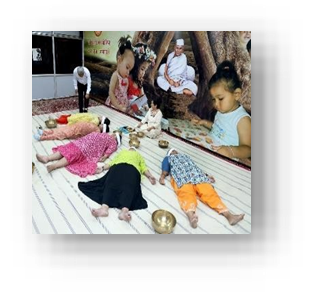
Master steps for Sound Healing:
Placement of singing bowl : Instruction for Sound therapist, Instruction for client
1. General Instruction for the Person, 2. Prayer for Healer, 3. Prayer for person 4. Relaxation for person, 5. Cord cutting, 6. Yog Nidra, 7. Aura cleaning, 8. Brain wave Relaxation, 9. Chakra cleaning and strengthen, 10. Aura cleaning, 11. Aura strengthens, 12. Aura cleaning for yourself & Thanks to Master 13. Closing the session
(Stanhope,J. &Weinstein P.,2020)11
Results: The collected data was tabulated and analyzed. The mean and S.D. were calculated and t-test was applied to find out the significance of the data.
Result Table – 1
Null Hypothesis (h0): There is no significant difference in the anxiety level of women.
| Women Anxiety level | |||||
| Group | Mean | SD | r | t-value | S.L. |
| Pre Experiment | 34.75 | 11.53 | 0.64 | 3.58 | 0.01 |
| Post Experiment | 27.20 | 9.80 | |||
| N=20, df= 19, Significant at 0.01 level | |||||
The Null Hypothesis has been rejected at .01 level of confidence.
From Table –1 it is clear that practicing Sound healing meditation reduces the anxiety level of mean is 34.75 to
27.20 of women, and the t-value obtained is significant at 0.01 level. Result can be concluded that the effect of sound healing meditation has resulted in reduction in anxiety level of women.
Table – 2
Null Hypothesis (h0): There is no significant difference in the Alfa E.E.G level of women.
| Women Alfa E.E.G. level | |||||
| Group | Mean | SD | r | t-value | S.L. |
| Pre Experiment | 5.50 | 2.50 | 0.39 | 2.50 | 0.05 |
| Post Experiment | 7.77 | 4.20 | |||
| N=20, df= 19, Significant at 0.01 level | |||||
The Null Hypothesis has been rejected at 0.05 level of confidence.
From Table –2 it is clear that practicing Sound healing meditation reduces the Alfa E.E. G. Level of mean is 5.50 to 7.77 of women, and the t-value obtained is significant at 0.01 level. Result can be concluded that the effect of sound healing meditation has resulted in reduction in anxiety level and Alfa E.E.G. level increased of women.
Table – 3
Null Hypothesis (h0):: There is no significant difference in the G.S.R. level of women.
| Group | Mean | SD | r | t-value | S.L. |
| Pre Experiment | 185.7 | 136.3 | 0.78 | 3.19 | 0.01 |
| Post Experiment | 258.1 | 156.3 | |||
| N=20, df= 19, Significant at 0.01 level | |||||
The Null Hypothesis has been rejected at .01 level of confidence.
From Table –3 it is clear that practicing Sound healing meditation reduces the G.S.R. Level of mean is 185.7 to
258.1of women, and the t-value obtained is significant at 0.01 level. Result can be concluded that the effect of sound healing meditation has resulted in reduction in anxiety level and G.S.R.. level increased of women.
Table -4 Null Hypothesis (h0): : There is no significant difference in the stress level of women.
| Women Stress level | |||||
| Group | Mean | SD | r | t-value | S.L. |
| Pre Experiment | 128.15 | 38.4 | 0.90 | 6.85 | 0.01 |
| Post Experiment | 102.75 | 35.76 | |||
| N=20, df= 19, Significant at 0.01 level | |||||
The Null Hypothesis has been rejected at .01 level of confidence.
From Table –3 it is clear that practicing Sound healing meditation reduces the anxiety level of mean is 128.15 to 102.75 of women, and the t-value obtained is significant at 0.01 level. Result can be concluded that the effect of sound healing meditation has resulted in reduction in stress level of women.(Garette,1926)
Interpretation & Discussion
The study on the bases of its outcomes can be treated as a fruitful and important piece of research about the women health. Sound will play key role in generating in our body. Sound will relax your entire body by focusing on nucleus that is brain. Within 6 to 7 minutes a person’s brain will go from Beta to Alpha state that is from consciousness to sub consciousness. Sub consciousness means deep relaxation state of mind. When you listen to soothing sounds, your body releases endorphins, serotonin, dopamine, oxytocin, and norepinephrine. (Komer, 2001).13 These feel-good chemicals make us happy and help move us out of a fight or flight stress response. They also reduce blood pressure and heart rate, which promotes deep states of relaxation. Listening to soothing music before bedtime can make us sleepy and can improve sleep quality. This is because the relaxation response is triggered by slow brain waves, such as those produced by deep meditation. (Pandya,2003)14 Listening to relaxing music before bedtime can help you fall asleep faster and stay asleep longer. And since sound therapy reduces stress, it can help you wake up feeling refreshed.
Conclusion
This indicates that during meditation, the brain transitions from an active, alert state (beta) to a more relaxed, calm state (alpha and theta). Through this, primarily to enhance the capacity of brain and other internal organs, so that individual can use their powers properly for the best use being physically and mentally healthy (peace, happiness, bliss and self- realization). Sound meditation can be very effective as a therapeutic technique against anxiety & stress.